The Missing Infrastructure for Planetary Defense
Matt Gialich

This is the first in a four-part series exploring the broader consequences of lowering the cost per kilogram of access to deep space. Resource extraction is our mission, and the technologies and operational capabilities required to achieve it have applications that extend far beyond mining itself. We begin with planetary defense.
Nearly four years ago, a spacecraft roughly the size of a small car smashed into an asteroid and changed history.
When NASA’s DART collided with the 160-meter asteroid moonlet Dimorphos, it successfully shortened the rock’s orbit around its parent asteroid by a little over half an hour. For the first time, humanity demonstrated that, under the right circumstances, we can change the trajectory of a celestial body.
It was a crucial test of our ability to protect ourselves from a threat that is statistically inescapable: an asteroid on a collision course with Earth. Impacts have happened before and they will happen again. Depending on the object, the damage could range from shattered windows across a city to regional devastation to global catastrophe.
DART answered an important question. But in doing so, it highlighted a more fundamental issue: before we can decide how to respond to a potentially hazardous asteroid, we must first detect it, characterize it, and understand it.
What DART showed is that planetary defense begins long before deflection. It begins with information.
Deflection starts with information
When we think of planetary defense, we think of something from Hollywood: a harrowing last-minute mission to save the world and a death-defying encounter between astronauts and an asteroid. In reality, it is far less cinematic.
At its core, planetary defense is about preparedness: taking action as quickly as possible as long in advance after a possible threat is detected.
The first step is information. Before we can determine how to respond to an asteroid, we need to know whether it poses a threat at all, and how severe that threat may be. We need to understand its orbit, its size, its composition, its structure, and how it might respond to different deflection strategies. These are not academic questions. They determine what options are available and how much time we have to act.
Consider the case of object 2024 YR4. Roughly 60 meters across, it threatened to trigger a devastating regional catastrophe on the scale of the 1908 Tunguska event, which leveled some 80 million trees across Siberia with an explosive yield roughly a thousand times that of the atomic bomb dropped on Hiroshima.
After a survey telescope in Chile discovered the object, it drew international attention when its estimated chance of striking Earth in 2032 climbed past one percent, then higher still, until it briefly held the highest impact probability ever recorded for an asteroid of its size. International observatories and national space agencies stepped up monitoring, and as more observations came in, the likelihood of impact eventually collapsed to zero.
As additional observations came in, astronomers were able to narrow the uncertainty around the asteroid’s orbit until the probability of an impact disappeared. That is the first step in planetary defense: reducing uncertainty until we can confidently distinguish between a genuine threat and a harmless flyby.
On this point, the world is deeply under-prepared.
Cataloguing the problem
Humanity has discovered tens of thousands of near-Earth objects (NEOs), and astronomers sort them largely by size. Tracking programs coordinated by NASA's Center for Near-Earth Object Studies and the Minor Planet Center have catalogued more than 95% of the asteroids over one kilometer in diameter, or large enough to threaten global catastrophe. But we have identified only 40% of those larger than 140 meters and fewer than one in ten of those between 50 and 140 meters. While these smaller objects would not end humanity, they could still devastate a region or obliterate a city.
In 2005, Congress directed NASA to close that gap and catalogue 90% of the NEOs larger than 140 meters by 2020. That deadline has long passed, and the survey is still less than halfway complete despite NASA’s own estimates that finishing it would remove 99% of the risk from an unexpected impact. Put simply, asteroids are hard to detect. Their diminutive size compared to planets and their often dark surfaces make it so that, in total, they reflect very little sunlight to make them stand out amongst the star field.
NASA is still taking action. Its NEO Surveyor mission, preparing for launch later this decade, is built in part to hunt down those missing asteroids and close one of the largest gaps in our understanding of the NEO population. The infrared telescope will sit at the Sun-Earth L1 Lagrange point for at least five years searching for the asteroids typically hidden from ground observatories by the Sun’s intense glare. NEO Surveyor will detect the thermal infrared “glow” (i.e., the heat) of small asteroids that are otherwise too dim to easily detect by reflected sunlight.
Knowing where an asteroid is only solves part of the problem. Even when its orbit is well understood, many of its most important physical properties remain unknown. We have visited fewer than thirty asteroids with a spacecraft. Yet for the vast majority of NEOs, we do not know anything about their detailed composition, internal structure, density, or other properties.
How we would deflect one depends heavily on those details. Nudging a solid iron-nickel body is different from nudging a loose pile of concrete-like or even clay-rich boulders. A rapidly spinning asteroid would react differently than a slowly rotating one. A heavily fractured asteroid may break up into a spray of smaller pieces if we impacted it in the wrong way.
One of the most important unknowns is mass. The energy of an impact depends on both velocity and mass, making mass a critical variable in understanding the consequences of an impact. Determining it requires more than tracking an asteroid’s orbit. At AstroForge, we are developing several payloads to determine an object’s size and volume, estimate the density of its material, and assess whether it is a solid body or a porous rubble pile. We are also developing more advanced mission architectures to measure how the asteroid’s gravity subtly perturbes the trajectories of nearby spacecraft.
For most asteroids, however, our knowledge is limited to what can be inferred from terrestrial observatories and orbiting telescopes positioned millions of miles from their targets.
DART itself demonstrated the limits of what can be understood from afar. Following the impact, scientists confirmed something they suspected but couldn’t verify in advance: that Dimorphos was non-cohesive, or a loosely packed “rubble pile.” The spacecraft collision with the surface triggered a jet of rocks and dust into space, the recoil of which acted like a small jet engine, resulting in a momentum transfer that exceeded that which was provided by the spacecraft alone.
In this case, the loose, rubbly nature of Dimorphos actually made DART’s deflection more effective. In a real planetary defense scenario, understanding an asteroid’s composition will help determine not only which deflection strategy would be effective, but how to best architect the spacecraft and mission parameters to succeed.
If we want to understand the properties that determine whether a deflection would be effective, we need to go to the source.
Low-cost access to small bodies
Low cost, repeatable missions to small bodies are not yet part of any nation’s planetary defense program, because the capability has never been available before. But we are building exactly at AstroForge – for asteroid mining.
Our next mission, DeepSpace-2, will travel to a metallic asteroid and image it up close. It is a rendezvous and characterization mission, exactly the kind that astronomers and planetary defense officers would need. We are conducting resource exploration in space to identify the richest metallic mining targets. But the byproduct is a fleet of small spacecraft, operational experience around small bodies, and new characterization data that builds on the asteroid catalogs already maintained by the planetary science and defense community. That will form the characterization and response infrastructure planetary defense has always lacked.
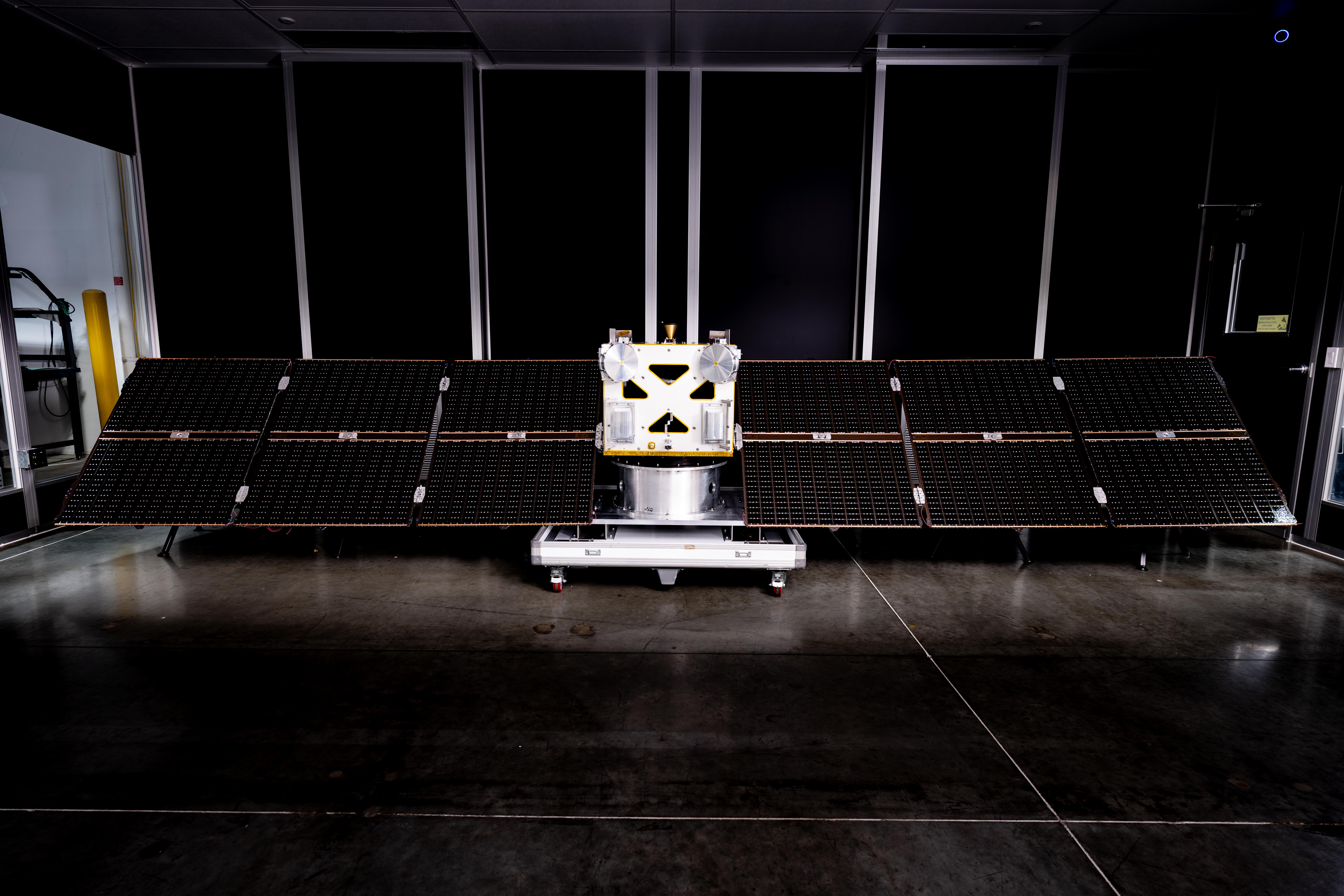
At the moment, once a threat is discovered, there is no rapid and scalable way to reach it. Large, institutional planetary defense spacecraft are custom-built and expensive with lengthy development and testing cycles. These missions assume years or decades of warning time.
Not every threat will arrive with decades of notice. If a hazardous asteroid was discovered on a trajectory targeting Earth with only a few years of warning, a traditional flagship mission would take too long to build. For an urgent enough threat, humanity could certainly marshal the resources to move faster, but it would come at an extremely high expense. We are proposing an alternative so we don’t have to: a nimble fleet of commercial spacecraft, already operating beyond Earth orbit, and already traveling to asteroids.
Because we intend to manufacture spacecraft at volume, we expect to have a vehicle ready to launch within 2 months. That spacecraft could flyby any potentially hazardous object to get its makeup, size, and refine its orbit. We are also developing the capability to rapidly reposition spacecraft, so that assets that are already in deep space can be repurposed toward a new target.
After information comes deflection
Mining requires us to solve a second problem that overlaps with planetary defense: interacting with an asteroid once we arrive.
We are developing laser-based technologies to extract and process asteroid material. However, the same physics has broader applications beyond mining. When a laser vaporizes material on an asteroid’s surface, the resulting plume of vapor and droplets exert a small force in the opposite direction. Over time, that force can act like a tiny thruster, gradually altering the asteroid’s trajectory. This is much like the result of the DART impact on Dimorphos, but in a more controlled and tunable manner that doesn’t also immediately cost you your entire spacecraft.
The effect is subtle, but given enough warning time, even a slight change in velocity could cause an asteroid to bypass Earth entirely. For now, the technique is best suited to the metallic asteroids we are targeting for resource extraction, where a DART-like impact is likely a less effective solution anyway. But it illustrates a broader point that commercial technologies required to build a deep space economy often overlap with the technologies required to protect the Earth from asteroid impacts.
Metal is the incentive
There is a reason this deep space infrastructure does not already exist: there is no planetary defense market. No one buys continuous asteroid characterization or on-demand deflection, despite the fact that the safety of the planet benefits everyone.
AstroForge does not need that market to exist. Our business is built around the extraction and sale of highly concentrated platinum group metals from asteroids. The same spacecraft, the same ability to quickly change out payload, and the same capabilities to pursue that goal can also benefit planetary defense.
We will become the first company to maintain a persistent commercial presence in deep space, and in doing so we can help create something governments have never been able to fund on their own: a continuously expanding understanding of the NEO population and a low-cost way to reach them.
Governments will continue to lead planetary defense efforts. But history has repeatedly shown that exploration accelerates with an economic incentive. The metal is ours.
We are building spacecraft to find, reach, and ultimately extract asteroid resources. In doing so, we are also building the infrastructure required to understand the small-body population at a scale that has never been economically possible before.
We are building for the metal. As a consequence, we are also building the infrastructure that will help humanity understand and defend itself from the small bodies that share our Solar System.