The Next Frontier of Deep Space
Matt Gialich
Of the millions of bodies that orbit our Sun, only the tiniest percentage are planets. The vast majority are smaller, simpler, and largely untouched since their formation. And for almost all of human history, we did not know they existed.
That discovery came on the first evening of the nineteenth century, when Italian astronomer Giuseppe Piazzi peered through his telescope and very nearly misidentified the discovery of his life. He initially thought the unidentified, slow-moving celestial body was the long-theorized “missing planet” between Mars and Jupiter. But it wasn’t a planet – it was Ceres, the first known object in the asteroid belt.
More than two centuries later, scientists use asteroids as a looking glass into how our Solar System formed. But we are still in the very early stages of understanding them, and their importance extends far beyond science: If we intend to fully understand and realize their value, we will eventually need to reach, characterize, and interact with these objects routinely and affordably.
Even what little we know points to their value. Some asteroids contain unusually high concentrations of platinum group metals, resources that could be extracted and returned to Earth to fuel the growth of advanced industry. A small number pose a potential threat to Earth. And as human activity expands into the Solar System, the ability to identify, inspect, and understand objects in deep space will become strategically important as well.
This is why we believe small bodies are the next major frontier of deep-space operations.
Deep Space Is Still Rare
For most of human history, reaching these bodies was an impossibility. That’s been true for most of the space age, too. Although we have catalogued over a million small bodies in our Solar System, humanity has only visited a few dozen and returned material from three.
The missions that succeeded were exquisite, and enormously expensive: NASA’s OSIRIS-REx, which returned samples from asteroid Bennu in 2023, and JAXA’s Hayabasu and Hayabasu-2 return missions all required over $1 billion in total mission costs.
These missions returned extraordinary science. But when discovery costs hundreds of millions, or even billions, of dollars, cost determines the cadence of exploration.
When a single mission costs that much and takes a decade to fly, you can only fly a few, and you have to be absolutely certain that each mission will succeed. As a result, organizations become highly risk-averse, because failure is so expensive. Development timelines stretch from months to years to decades to ensure every system is tested, and tested again. This model effectively locks out everyone but superpowers and national space agencies from deep space.
AstroForge was founded to break that model. It breaks when the cost of reaching and operating beyond Earth orbit becomes cheap enough to do routinely.
From LEO to Deep Space
We’ve already seen this happen in low Earth orbit. Reusable rockets lowered the cost of launch, and spacecraft build costs have fallen alongside it. These changes brought a transformation to LEO, with entire industries emerging around satellite broadband, Earth observation, national security, and remote sensing. A similar transition is coming to deep space.
A major reason this transition is becoming possible now is the rapid expansion of cislunar activity. Historically, missions beyond Earth orbit were rare precisely because it was so expensive to leave Earth orbit at all. It required a dedicated heavy-lift launch rocket, like the Delta IV or a SpaceX Falcon Heavy, adding hundreds of millions of dollars to the mission cost. The rise of commercial lunar missions is changing that equation. NASA’s Commercial Lunar Payload Services program and the broader push to build a sustained human presence on the Moon are creating new opportunities to reach cislunar space, access Lagrange points, and execute translunar injections to deep space.
Regular transportation between the Earth and Moon fundamentally lowers the barriers to entering the rest of the Solar System because most of the energy required to reach deep space is spent escaping Earth’s gravity well. By the time a spacecraft reaches cislunar space, much of that work has already been done. That makes lunar and cislunar missions not just destinations, but access points to go deeper into the Solar System. In the long term, resource return could even look different: asteroid material may not need to return directly to Earth, but could go instead to the lunar surface to support industrial activity there.
While launch and in-space transportation infrastructure is an important development, access alone will not unlock deep space. Deep space remains a uniquely difficult environment, and spacecraft operating there face fundamentally different challenges from those operating in Earth orbit.
Autonomy is essentially a requirement because real-time communication is virtually impossible. Outside Earth’s magnetosphere, spacecraft are exposed to harsher radiation and more extreme thermal conditions. Power is harder to come by as the spacecraft moves farther from the Sun. Communications links become weaker and more difficult to maintain across millions of kilometers.
Asteroids add another layer of difficulty. Many are irregularly shaped or simply piles of rubble, with mineral compositions that are only guessed at before arrival. Most have little to no gravitational field, which rules out conventional landing.
Until now, meeting these challenges meant building big and building expensive. But a series of technical advances – among them, smaller components, better onboard compute, more capable solar arrays, electric propulsion, autonomous navigation, and new communications architectures – now make it possible to build smaller spacecraft capable of operating far from Earth. And those same capabilities are not limited to asteroid mining, but instead become the foundation for lower-cost missions in multiple critical domains.
Four Domains To Unlock Deep Space
AstroForge’s vision has always been to unlock the mineral wealth of the Solar System through asteroid mining. But the consequences of lower-cost space missions extend far beyond mining. Once a spacecraft can reliably reach, inspect, and operate around small bodies at low cost, the same capability can be applied across several use cases in addition to resource extraction: planetary defense, science, and national security.
Planetary defense today is largely limited to detection and tracking. While we are able to find and track objects that might one day threaten Earth, our ability to reach a small body, characterize it, or test how it might be deflected is reserved only for the gravest threats. A repeatable, low-cost spacecraft changes the math on defense: it becomes possible to investigate objects while their probability of hitting Earth is still uncertain. We no longer have to wait for an emergency.
Scientific exploration is constrained by the massive budgets required to build, launch, and operate deep space missions. As a result, nearly everything we know about asteroids is extrapolated from the few dozen we have actually reached. Yet we know these bodies are remarkably diverse. Some are rocky and rich in silicate minerals. Others are carbonaceous, among the most primitive bodies in the Solar System, composed of carbon, hydrated clay minerals, and the organic compounds that are building blocks of life. Others still are metallic, and these are thought to be the exposed cores of disrupted protoplanets, dense with iron, nickel, and platinum group metals.
The problem is that we have visited so few of them. Universities and research institutions compete fiercely for the chance to fly an instrument, and ground-based observatories are limited in what they can reveal about any individual body. Low-cost missions change that. Researchers could study objects in their natural environment, at a timeline that would accelerate scientific development.
National security is becoming increasingly important as human activity expands beyond Earth orbit. Today, there are few commercial options for inspecting, characterizing, or responding to objects operating in cislunar space and other deep space regimes. The same capabilities required for asteroid missions, including autonomous navigation beyond GPS coverage, long-range communications, and low-cost operations, can also support space domain awareness and other national security objectives in contested space beyond GEO.
For decades, mining off-world to expand access to critical resources was dismissed as science fiction, but that is changing. Metallic asteroids hold PGMs at concentrations that dwarf what is accessible on Earth. These materials are essential for scaling AI compute, advanced manufacturing, electrification, and other critical industries. As high-grade terrestrial deposits decline, we see metal-rich asteroids as the next logical place for extraction.
A Different Paradigm
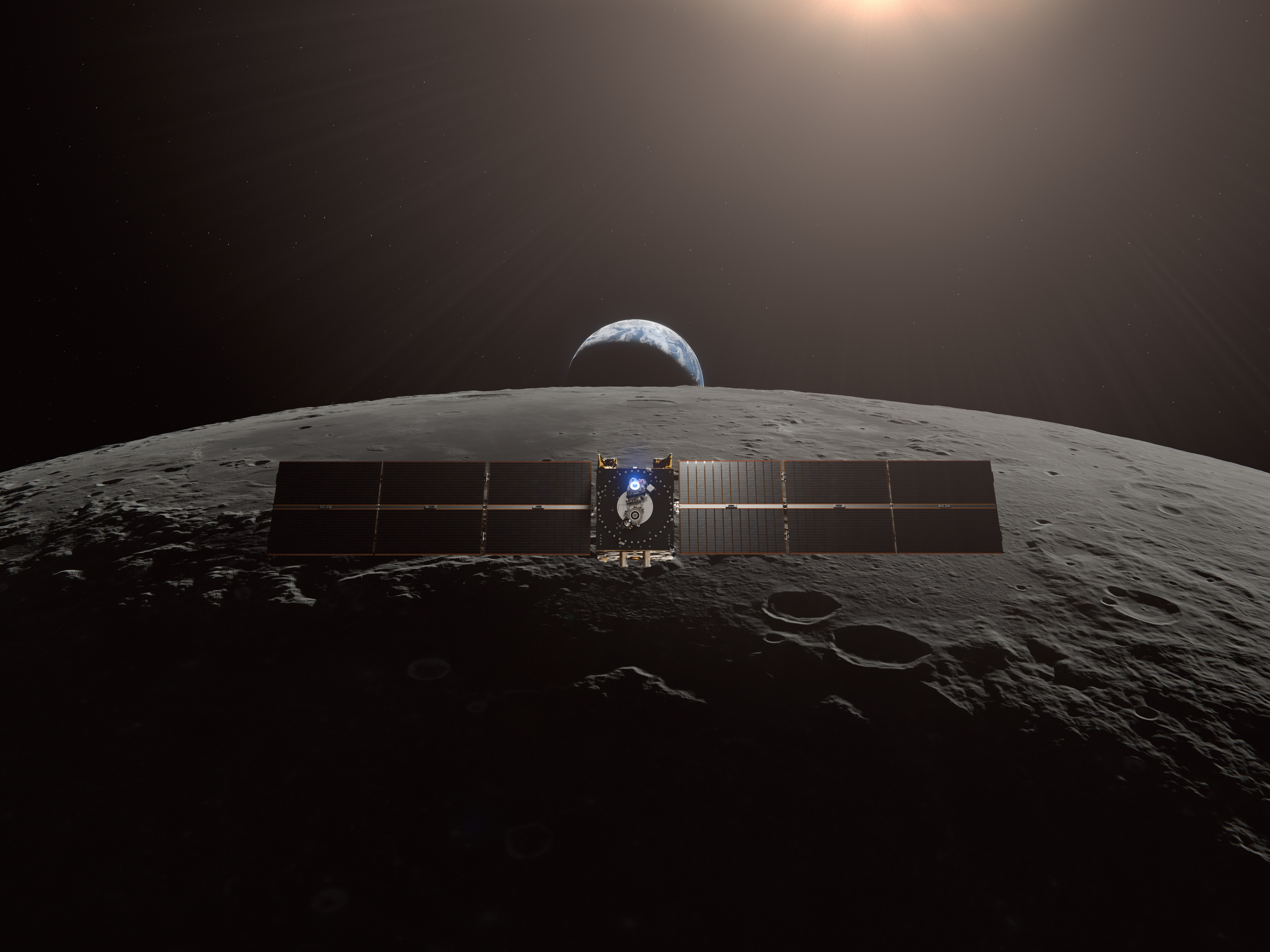
The path to sustained, routine activity in deep space is low-cost missions using small, highly capable spacecraft. AstroForge is building that platform now, starting with our next mission, DeepSpace-2, which will attempt to rendezvous with and land on a metallic asteroid.
Asteroid mining is the venture-scale opportunity behind this effort, and the reason we are solving these problems in the first place. But the underlying capabilities required to make mining possible – to identify viable targets, operate the spacecraft with limited communications from Earth, rendezvous with small or poorly characterized bodies, land and extract material, process it, and return it to Earth – can generate value much earlier across planetary defense, science, and national security.
Engineered for repeatability, future missions using our platform will cost less than $10 million, inclusive of launch. This cost has never been reached before by any entity, public or private. Lower cost missions fundamentally change what is possible. Mission frequency increases, and with it, the number of private entities that can answer scientific questions, fly commercial payloads, or explore the Solar System. Governments can fly more science. New markets can emerge.
That is the philosophy behind DeepSpace: the future of deep space belongs to whoever can learn the fastest. By lowering costs, we’re creating more shots on goal, and more opportunities to win.
The answer to this problem must look different from traditional interplanetary missions. Our spacecraft is engineered to be inexpensive enough that we can afford to be wrong, learn lessons in the real flight environment, and try again. DeepSpace-2 is where this mission begins.
DeepSpace-2
This year, DeepSpace-2 will launch on a Falcon 9, perform a translunar injection, and follow the path the Apollo astronauts first traveled beyond Earth. It will eventually depart Earth’s gravity well entirely. Nine months later, it will rendezvous with a metal asteroid and attempt to land on its surface. Onboard, a panchromatic high-resolution camera will capture images of the body’s shape and structure, and provide the first clues to its mineral composition.
We are at the very beginning of our extension beyond Earth orbit. The next era of humanity’s presence in deep space will be marked by more: more missions, more destinations, more organizations participating in scientific discovery and deep space industry. The transition will not happen overnight. We understand well that deep space is unforgiving. But the first step to any new market is access, and we are opening that with our spacecraft bus.
Reusable rockets transformed low Earth orbit into a bustling site for industry. We believe low-cost interplanetary spacecraft will do the same for deep space.
The long-term future for planetary defense, scientific exploration, national security beyond Earth orbit, and asteroid mining depends on this capability: being able to reach and operate around small bodies repeatedly and affordably.
This is the future AstroForge is building.