We Built the Spacecraft
Matt Gialich
Reaching deep space is about to become routine.
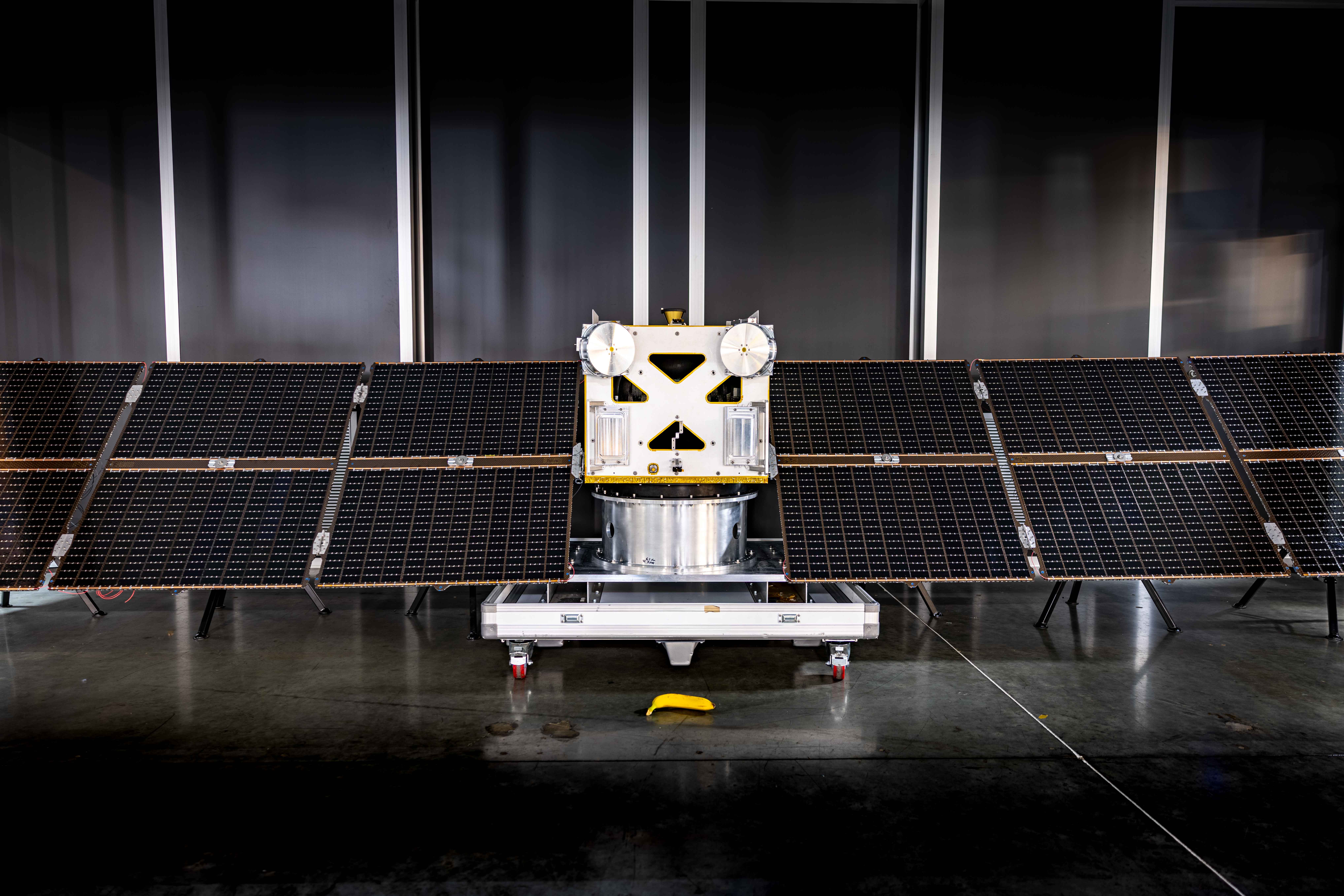
Last month, we assembled the major flight hardware of DeepSpace-2 on our integration floor for the first time.
This is the full flight vehicle, ready for testing and further refinement as we prepare for launch in the fourth quarter of this year. Like all complex systems operating in harsh environments, the vehicle will continue to evolve and improve as we move through the test campaign in the months ahead. This iteration cycle is part of how we will win.
This spacecraft was built on a single conviction: that deep space is the next domain for exploration and industry, and small bodies are how we get there. By visiting, characterizing, and ultimately mining the many asteroids near Earth, humanity can build a true industrial economy in space and begin expanding into the Solar System.
For most of human history, the Solar System was merely a scatter of pinprick lights in the sky. Only recently did we learn that planets are joined by millions of small bodies orbiting the Sun: asteroids. Humanity has catalogued more than a million of these objects. We’ve visited less than thirty, and returned material from just three.
Those missions belonged almost entirely to superpowers and national agencies. They demanded billion-dollar budgets, decade-long development timelines, and exquisite systems engineered to drive risk as close to zero as possible. This model of space exploration achieved extraordinary things. It landed rovers on Mars, launched observatories that transformed how we see the cosmos, and returned samples of asteroids retrieved from their natural environment.
But it also ensured that reaching deep space remained rare.
DeepSpace-2 is an early step toward changing that.
We believe the future of deep space will look different from its past. It will be built on low-cost, rapidly iterated spacecraft that roll off a production line and fly often. And small bodies are the scientific and economic engine that will make it possible.
Deep Space is Next
We believe deep space is about to undergo the same transition low Earth orbit experienced over the last decade, when reusable rockets lowered the costs of launch and spacecraft became cheaper to build. As a result of those shifts, entirely new industries emerged around satellite broadband, Earth observation, remote sensing, and national security.
But beyond Earth orbit, the economics have barely moved. That’s because there has never been a commercial reason to reach deep space repeatedly, and so no reason to build the kind of spacecraft deep space actually needs: smaller, lower-cost, and modular.
DeepSpace-2 is exactly that.
Launching this fall, DeepSpace-2 will travel millions of kilometers into deep space to rendezvous with and image a near-Earth asteroid. Using a high-resolution monochromatic camera, it will capture imagery designed to reveal the asteroid’s shape, structure, and give clues as to its mineral composition.
Built on our modular spacecraft platform, DeepSpace-2 is small compared to historical interplanetary spacecraft, weighing roughly 200 kilograms. Yet it carries the capabilities required to travel into deep space and rendezvous with and image an asteroid. Those include high-efficiency electric propulsion, high delta-v maneuverability, autonomous onboard computing, deep-space communications, and precision guidance and control.
More importantly, the spacecraft bus is designed as a platform. The vehicle will eventually support up to 50 kilograms of payload, including optical, infrared, RF, space-domain-awareness, spectroscopy, and mining systems. That enables missions ranging from resource prospecting and extraction, to rendezvous and proximity operations, scientific exploration, and planetary defense.
What DeepSpace-2 Unlocks
The ability to routinely reach asteroids means humanity gains the ability to operate throughout the Solar System, instead of remaining confined to the narrow orbital bands around Earth.
This capability has wide-reaching implications.
Right now, planetary defense missions are bespoke and enormously expensive, reserved only for the objects that pose a grave threat to Earth. But a repeatable, low-cost spacecraft widens the field of possibilities: we could investigate and characterize more objects, not only the rare ones that are absolutely certain to hit Earth, and learn about them while the probabilities are still uncertain.
Similarly, scientific discovery beyond Earth orbit is constrained by national-scale budgets. Much of what we know is extrapolated from the twenty or so bodies we have managed to reach. Research institutions and universities compete fiercely for the chance to fly their instruments on one of these missions, and terrestrial observatories can only reveal so much about any given body in space. Our interplanetary vehicle will mean more missions, more payloads carried, and cycles of scientific discovery that occur at a rate never seen before.
Longer term, many asteroids are extraordinarily rich in critical materials required to scale AI compute, electrification, advanced manufacturing, and America’s industrial goals. As terrestrial high-grade ore deposits decline, we believe the mineral wealth of the Solar System will become increasingly important to humanity’s advanced future.
Deep space remains unforgiving. We’ve learned that lesson before. But this milestone demonstrates that interplanetary spacecraft builds no longer have to be rare national achievements, but the product of a private industrial base and a small, ambitious team moving with purpose.
With DeepSpace-2, deep space will become the next operational domain for humanity.