Scaling Deep Space Science with Commercial Mining
Matt Gialich

This is the second in a four-part series exploring the broader consequences of lowering the cost per kilogram of access to deep space. Resource extraction is our mission, and the technologies and operational capabilities required to achieve it have applications that extend far beyond mining itself. Read our first post in the series, about planetary defense, here.
Shortly after the turn of the twentieth century, in a dim room at the Harvard College Observatory, our understanding of the cosmos permanently shifted.
A young astronomer named Henrietta Leavitt spent her days measuring the brightness of stars captured on photographic glass plates. This was a revolutionary new technology at the time, enabling astronomers to capture thousands of stars in a single exposure and track changes across the night sky over months and years. By painstakingly comparing these plates, Leavitt catalogued more than 1,500 “variable” stars characterized by repeated and predictable cycles of brightening and dimming. In doing so, she discovered a startling pattern: the brighter the star, the longer its blinking cycle.
This period-luminosity relationship became the bedrock for measuring distances across the universe. Less than two decades later, Edwin Hubble used Leavitt’s work to prove that the Andromeda Nebula was an entirely separate galaxy, and to demonstrate that our universe was expanding.
Throughout the history of science, we see that lowering the cost of observation speeds up the rate of discovery. Cosmology experienced a profound sea change because a technological breakthrough enabled an exponential leap in the number of observations scientists could collect. Today, planetary science faces a similar bottleneck. The field is rich in questions, but desperately starved of physical observations. Planetary science has a sample size problem.
Just as photographic plates unlocked a new era of astronomy, routine deep space operations will unlock a new era of planetary science. By dramatically lowering the cost of reaching, operating around, and characterizing worlds throughout the Solar System, the platform we’re building for asteroid mining can transform deep space science from a handful of flagship missions into hundreds of focused expeditions.
The cost gap we intend to close is dramatic. NASA’s most risk-tolerant category of planetary missions, ones that accept a higher probability of failure, still cost on the order of $100 million including launch, and such missions fly less than once per year. The most risk-averse missions run about a half a billion dollars, with a decade or more of development. The bottleneck to more science is not only what a mission costs, but how often we can fly them.
In contrast, our spacecraft is designed to be mass manufactured and flown at a high cadence, because asteroid mining demands it. The same production line can put a dedicated science mission in deep space for a fraction of those figures, at a flight rate measured in missions per year rather than missions per decade.
When prices drop, scientific inquiry expands. Scientists no longer need to wait a decade to fly their instrument; a surprising discovery can get a follow-on mission in a matter of years. And when the risk posture changes, science accelerates. Low cost access to deep space will open up a new era of exploration.
The constraint
The dearth of direct observations spans the Solar System. Every destination, from the Moon, to Mars, Venus, asteroids, and the outer planets, carries a list of scientific questions far longer than the number of missions currently budgeted to go there.
Consider Venus. Playfully referred to as Earth’s “evil twin,” the planet is similar in size to our own, yet it became a toxic furnace while Earth became a garden. There are myriad questions about how Venus evolved: did it have oceans? Was it once habitable before something went catastrophically wrong? If so, what happened? Could its clouds today harbor microbial life? These are some of the biggest mysteries in planetary science today, and they have a direct bearing on our own future as one possible path Earth itself could take.
Yet, in more than sixty years of spaceflight, NASA has performed twelve flybys, and only a handful were dedicated missions to Venus. Nearly everything we know about the surface comes from a single radar mapper, the Magellan orbiter, that operated in the early 1990s. Venus scientists have substantial disagreements about how the planet’s surface came to be covered in volcanoes and impact craters, yet their competing theories must rely on decades-old measurements.
Venus is not an exception. While Mars has been more extensively studied, we still must extrapolate findings from remote sensing and just a few select landing sites to 4+ billion years of global geologic history. Millions of asteroids are drifting through the Solar System, containing a record of how the planets formed, and we have visited fewer than thirty. Just two NASA missions have gone to Mercury, and the missions were gapped by a period of nearly forty years.
Despite these limitations, every single planetary probe or asteroid flyby has fundamentally transformed our understanding of the Solar System. We discovered that what we assumed were solid rocks are often loose rubble piles. We found seas of liquid methane on Titan, and we learned that water ice exists in the permanently shadowed craters of the Moon.
These dynamic worlds are badly undersampled, and many of the questions are population-level questions across time and space: How does Venus's climate change year to year? Is its volcanism continuous or episodic? What is happening inside its clouds right now? We do not know, because nothing of ours is there to see it.
Every new mission we fly is another data point. Right now, we simply aren’t flying enough of them.
The limits of remote sensing
For every destination we cannot reach, we depend on remote observations. And everywhere in the Solar System, remote observations only tell a fraction of the story. Nowhere is that clearer than Venus.
Venus is a particularly challenging object of study because its dense, sulphuric clouds make it completely opaque to telescopes. What we understand of its terrain we know due to radar, not photography. In 2020, astronomers announced they found evidence of phosphine, a gas associated with microbes, present in Venus’ atmosphere. The discovery sparked a massive debate about whether life might exist on the planet – a debate that is still ongoing, and likely will continue to be, until we can send a spacecraft to the planet to investigate up-close.
Meanwhile, our ability to discover has never been greater. Digital detectors and automated survey telescopes have catalogued over a million asteroids, identified distant moons, and found thousands of planets around other stars. Discovery became cheap, but visiting never did, and this asymmetry defines modern planetary science. We can see the worlds, but rarely can we reach them.
More frequent missions to deep space are actually poised to strengthen terrestrial assets. Telescopic surveys are how new worlds are discovered, how their orbits are tracked, and a major part of how AstroForge will identify its mining targets. Every time a spacecraft measures a world up close, whether that is an asteroid, a moon, or a planet, that ground truth sharpens the interpretation of remote observations. The entire pipeline of knowledge stands to become more robust with low-cost access to deep space.
When spacecraft do actually visit a celestial body, we are almost always surprised. Astronomers once imagined a warm, tropical world beneath Venus’s clouds, until probes measured a surface hot enough to melt lead. Pluto was just the faintest blur in telescopes until New Horizons found nitrogen glaciers flowing between mountains of solid water ice. And when OSIRIS-REx arrived at asteroid Bennu, scientists didn’t find the smooth surface they were expecting, but instead a jagged and unexpectedly cracked boulder pile. These are facts we could’ve never discovered from the ground.
Breaking the bespoke paradigm
The sample size problem is, at its root, an access problem – and it’s one that spans every destination in the Solar System. For decades, deep space exploration has been a bespoke undertaking. A single spacecraft is designed, custom-built, and rigorously tested for one specific destination. Years are spent planning the mission, selecting the target, and minimizing every conceivable risk to safeguard a single multi-hundred-million-dollar opportunity.
While this risk averse paradigm has ensured the success of these missions, it keeps deep space missions rare, prohibitively expensive, and fundamentally unscalable.
But history shows that scientific progress accelerates when the tools of exploration become commoditized. Progress doesn’t happen because people are suddenly smarter; rather, it happens because tools become cheaper and easier to access, enabling scientists to collect data at previously unimaginable scales. Deep space science is waiting for its “photographic plate” moment.
Costly access to deep space hurts science in ways most people don’t realize. NASA funds remarkable scientific instruments every year, but many never fly. There simply aren’t enough rides. A billion-dollar flagship mission can only carry so much mass, consume so much power, and support so many teams. In addition, if an instrument faces development delays, it’s kicked off the mission entirely – with no backup ride.
As a result, getting a scientific payload to space is incredibly competitive and challenging. Consider NASA’s instrument development program, which exists specifically to carry new sensors across what the agency calls the “valley of death” – the gap between a promising laboratory instrument and one mature enough to fly. Even if an instrument survives that valley, the scientists behind it only earn a right to compete for a ride. Competition for those missions is a tight funnel. Each round of NASA’s Discovery and PRISM programs attracts dozens of fully developed mission concepts that must compete for a single selection.
We can turn again to Venus to see how this plays out. After Magellan, three decades passed before NASA selected its next pair of dedicated Venus missions, in 2021, each budgeted at roughly half a billion dollars. Delays and budget pressure have since pushed both into the 2030s.
These instruments are also costly because they fly on billion-dollar spacecraft. Like the spacecraft itself, they are essentially over-engineered to ensure they don’t harm the mission or the bus. When NASA terminated the original magnetometer on the Europa Clipper mission in 2019, its projected costs had roughly tripled from the original proposal, to more than $45 million. This growth was attributed in part to the challenge of accommodating the instrument onto a billion-dollar spacecraft whose schedule and reliability requirements left almost no room for uncertainty.
Even finished spacecraft can get bumped. In 2020, NASA removed the EscaPADE spacecraft, a pair of Mars-bound smallsats, from their planned rideshare on the Psyche mission when the launch plans changed and the new trajectory could no longer deliver them. The twin probes had to be redesigned around a new spacecraft bus and manifested on another launch vehicle. When they finally launched in late 2025, five years after losing their first ride, the planets had moved: instead of cruising straight to Mars, the probes must now loiter at a Lagrange point for a year, waiting for the next planetary alignment.
We only need to look slightly closer to home to understand what happens to science when the economics of access change. When rideshare launches collapsed the cost of reaching low Earth orbit, science payloads that would never justify a dedicated mission began flying more frequently. When NASA started buying lunar delivery as a service through its CLPS program, it selected twelve instrument payloads in a single round. Even still, only about half have flown, and the demand swamps supply: a recent call for standalone lunar payloads drew 35 proposals for just three slots, revealing just how deeply the demand for in-space science goes.
CLPS is centered on getting science to the Moon. The much vaster arena of deep space has not yet experienced this transition. We still treat every deep space mission as though we must invent transportation from scratch, and as a result, transportation continues to dictate mission cost, payload selection, and constrain the pace of scientific discovery.
To break the bespoke paradigm, we have to change the economics of access. Then, we can imagine a future for deep space science where transportation no longer dominates the mission budget. The Solar System will always be fundamentally mysterious if we can’t access it. That is where asteroid mining fundamentally alters the equation.
Asteroid mining as a scientific engine
The first step in asteroid mining is prospecting. And prospecting is planetary science, simply conducted for commercial purposes. The operational questions we ask as a commercial asteroid mining company to close our business case are the fundamental questions that animate planetary science: what is a given object made of? How are its elements distributed on its surface? What is its rotational dynamic? What are the physical properties of its regolith?
At AstroForge, we are investing in the deep space infrastructure required to answer these questions at scale. A mining company cannot depend on a single successful asteroid mission, but an entire deep space operating system capable of visiting many bodies over many years. That’s why our mining bus isn’t bespoke, but based on a low-cost, repeatable architecture that can operate throughout the Solar System.
A spacecraft built to reach asteroids can reach far more than only asteroids. The same bus that prospects near Earth asteroids can orbit Venus, carry instruments to Mercury or Mars, or ferry a small probe into another world’s atmosphere. Our spacecraft can serve as a dedicated science platform for missions across the inner Solar System, flown for a fraction of the historical cost. NASA’s planetary science program budgets roughly $2.5 billion a year, so there’s no lack of funding or will – just access. If the first sixty years of spaceflight saw twelve Venus flybys of American spacecraft, there is no physical reason the next sixty years shouldn’t see one hundred.
Because our business model is predicated on processing and returning material, our spacecraft necessarily serves as a high-frequency platform for planetary science. At scale, commercial prospecting becomes a continuous, systematic survey of the asteroid population, and that flight cadence opens the door for everything else.
The public sector doesn't need to appropriate billions of dollars to achieve this cadence. The commercial value of asteroid refining funds the flight operations. By utilizing our standardized bus to carry scientific payloads, we can build a comprehensive map of the inner Solar System as a natural byproduct of our commercial operations.
This creates a powerful, self-reinforcing flywheel:
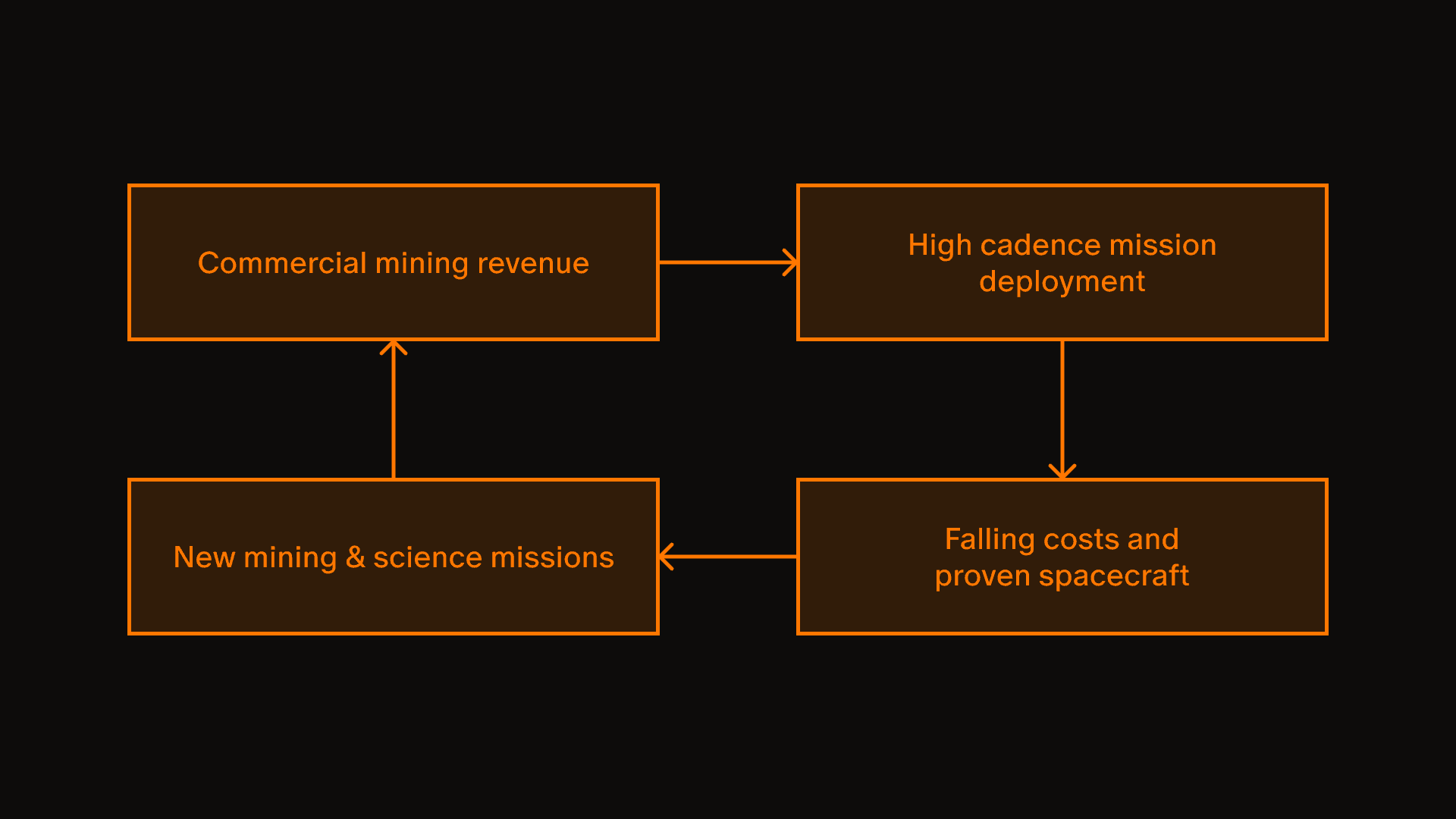
The bus can carry more than our own sensors. Our bus can fly the funded, flight-ready instruments waiting on shelves to lunar orbit, Venus, and vantage points across the inner Solar System. Commercial asteroid mining will unlock critical resources to support humanity's industrial future. But just as importantly, it provides the sustainable economic engine required to routinely reach deep space.
Henrietta Leavitt transformed our understanding of the cosmos because, for the first time, she had enough data to spot the hidden patterns of the stars. There are more patterns throughout the Solar System we have yet to uncover. The catalyst to go find them is metal, but the resulting explosion of knowledge will belong to everyone.